Tuesday, August 19, 2008

video from UK panel: "International Resistance to Zionism"

Below is the complete video from the International Resistance to Zionism panel that took place in London on Friday, July 11, 2008. Information about the event follows the video (you can click on each speaker's name to view their segment only).


We hope to add video from the San Francisco and the Los Angeles panels soon!

International Resistance to Zionism

London , 11 July 2008

In the first London meeting, with standing room only, of the new anti-Zionist initiative, the International Jewish Solidarity Network (IJSN), 120 people heard from activists organising in Egypt , Israel , France, US and the UK .

Selma James (IJSN UK) in the chair, opened by stating that the task is not only to be against Zionism but to show active opposition, and to take leadership from the Palestinian resistance against Zionism.

Michael Kalmanovitz (IJSN UK ) summed up the many enthusiastic and the (very) few hostile responses to the publicity for the meeting.

Daniel Machover renowned human rights lawyer, described how evidence from activists in Gaza had been gathered to use the “principle of universal jurisdiction” to indict Israelis suspected of war crimes. Notably, in 2005, his firm gave evidence to the London police about General Almog’s responsibility for dropping a one tonne bomb on Gaza , killing 15 civilians, nine of whom were children.

Although they ensured that a judge issued an arrest warrant for Almog when his plane landed in the UK , and although the police should have arrested him, the Israeli Embassy had warned him, and he returned to Israel on the sam e plane. Despite this, there is a long list of suspects, and it is only a matter of time before someone is arrested, in the UK or elsewhere.

Hossam El-Hamalawy
, Egyptian journalist and activist, reported on the biggest strike wave in Egypt for 50 years, centred on the textile factories in Mahalla where women had shamed men into going on strike. Later tax collectors, doctors and university professors had also gone on strike -- and won. There are 49 people from the Mahalla uprisings still in prison – support is urgently needed.

Mr El-Hamalawy stated that the Palestinian Intifadas had encouraged Egyptian people to resist their repressive government. Besides the strikes, there are other signs that they are winning: Egypt has been forced to withdraw from various agreements with Israel, including selling cement for the building of illegal settlements.

He considers that the IJSN’s uncompromising anti-Zionism is crucial in breaking with the monolithic image of Jewish people being for Israel and against Arab people.

Liliane Kaczerginski (IJSN Europe) is based in France. Her father was prominent in the armed resistance against the Nazis in Lithuania. She said that Zionism dishonours the genocide of European Jews. There is a Jewish tradition of organizing with dispossessed people, many Jewish people were Communists and Socialists, not Zionists.

She said that although there has been a Zionist invasion of Jewish minds we say no to a Jewish State because it means Jewish supremacy; we say no to the ethnic cleansing of Palestinian people. We are committed to the right of return for Palestinians and to a boycott, sanctions and disinvestment of Israel . Free Palestine in a Free World!

Sue Blackwell, from the British Committee for the Universities of Palestine (BRICUP), said that it is nonsense that universities in Israel are bastions of free speech. She quoted Palestinian academics who say that the Israeli academics serve in the army, including at the 600-plus check-points. Palestinian academics and students have not only been prevented from attending schools and universities, but hundreds have been imprisoned and killed.

The academic boycott campaign in the UK – calling for a boycott of Israeli institutions, including universities built on confiscated land -- has met with a lot of hostility from the Zionist lobby, including death threats. Nevertheless the campaign has had had a lot of success – watch this space!

Professor Moshe Machover, co-founder in 1962 of Matzpen, the Israeli Socialist Organization, said that opposition to Zionism was a necessary consequence of opposition to the colonialist nature of the State of Israel.

He said that Zionism accepts the premises of anti-Semitism: that Jewish people have to be kept outside of the societies where they live. Zionists promote the idea that you can have a Jewish identity only if you are religious or you are Zionist, even though many religious Jews are against the existence of the State of Israel.

He said that IJSN cuts through the debate between the one-state and the two-state solutions. This is a regional issue in an area where the political map was designed by French and English imperialists, including the map of Palestine . Present regimes in Jordan and Egypt are colluding with Israel in the repression of Palestinians. Professor Machover stressed we are not for the destruction of Israeli people -- the State of Israel must be overthrown, it is the State structure that must be destroyed.

A lively discussion followed: the meeting heard about the campaign for the boycott of Israeli goods at Rainbow Health Food Coop in San Francisco (RBIG); Jews for Boycotting Israeli Goods (J-BIG) quoted their slogan -- “It’s kosher to boycott Israeli goods”; Islington Friends of Yibna (IFY) described their campaign to twin Islington with Yibna, a Palestinian village destroyed in 1948; and Architects and Planners for Justice in Palestine (APJP) reported how Lord Rogers was told by the Israel Lobby that projects worth billions of dollars were in jeopardy unless he stated his support for the Apartheid Wall, which he promptly did.

Selma James, in her closing remarks said that we have to organize as Jews to undermine the identification between anti-Zionism and anti-Semitism; and finally, “If you oppose racism and war and neo-liberal and neo-conservative and genocide and fundamentalism in one place, it’s across the board. And that’s where our struggle begins.”

Thursday, August 7, 2008

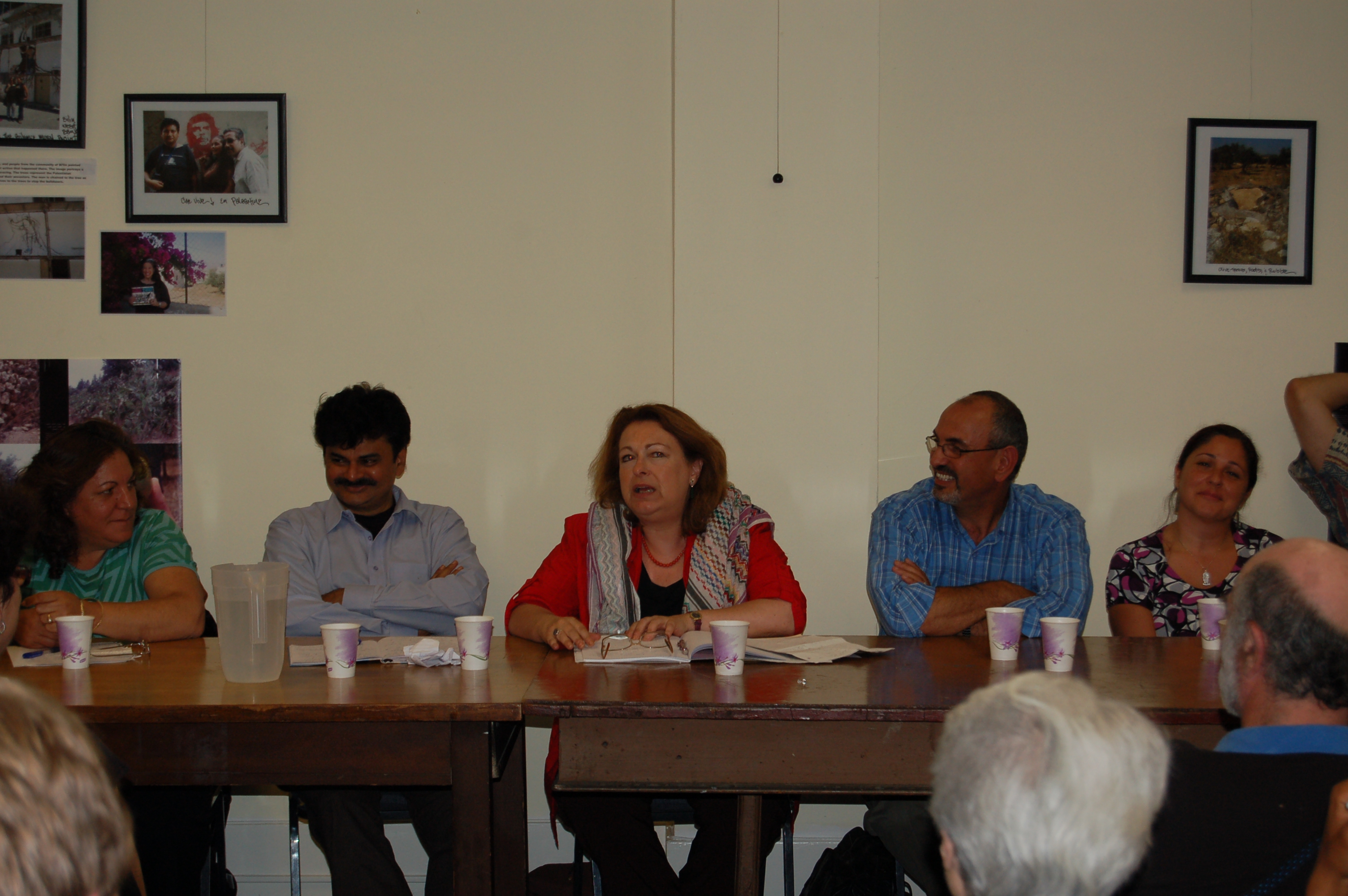
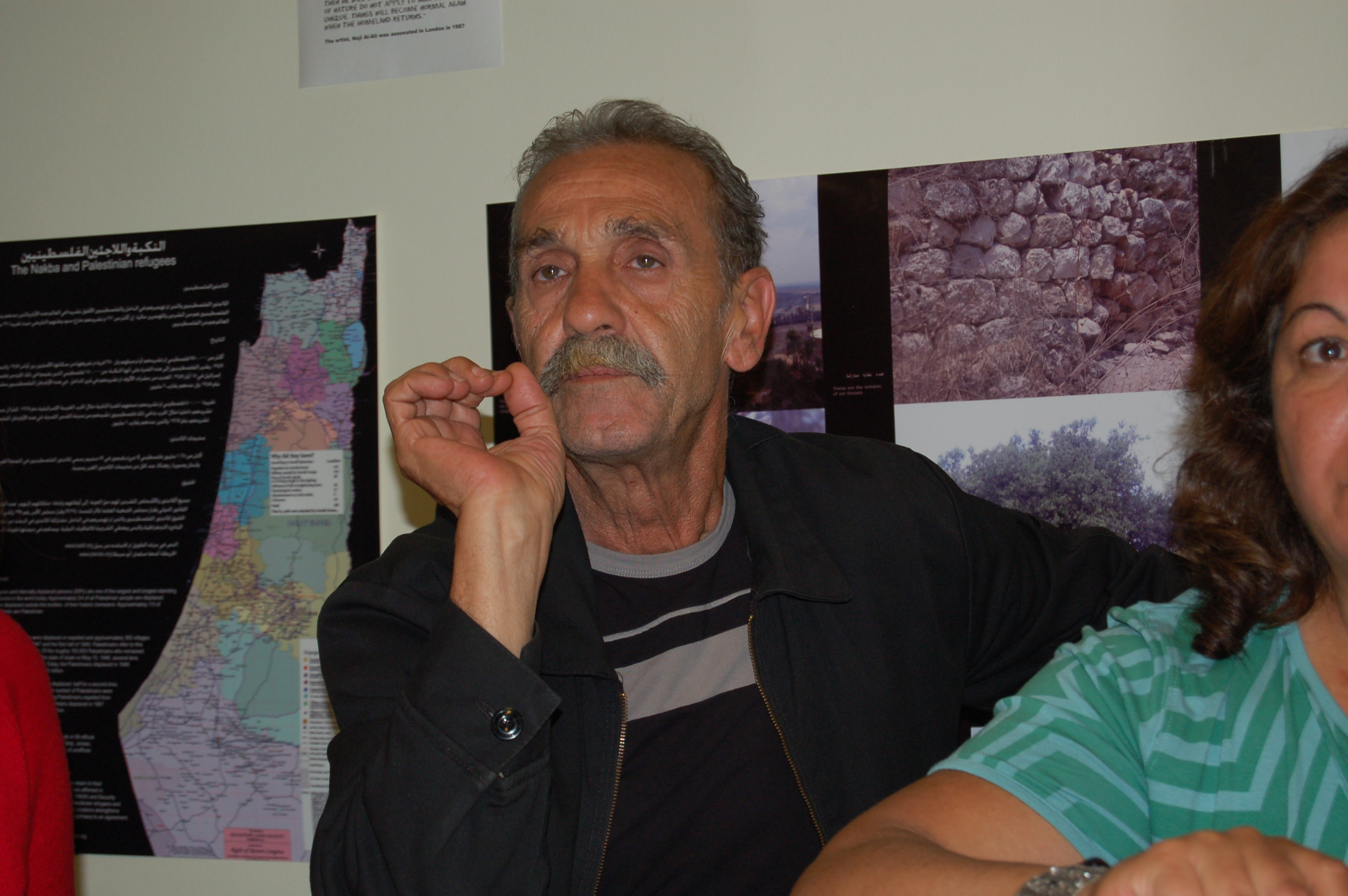
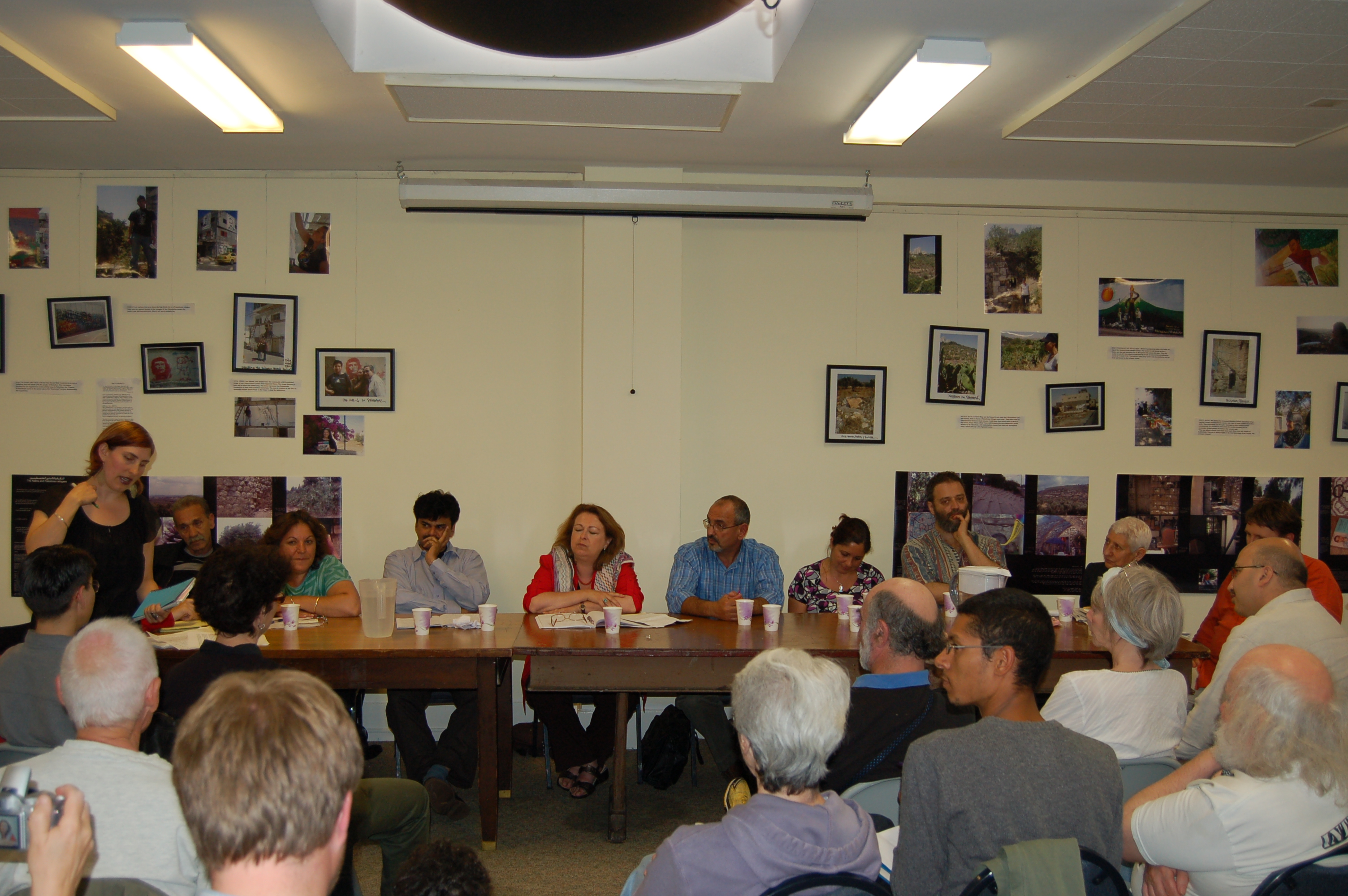
Photos from "International Resistance to Zionism" Panel (SF)

Here's a brief analysis from a local organizer who attended our panel last week, which filled the 522 Valencia Auditorium with close to 100 people:
A remarkable international panel broke new ground in the Bay Area, Wednesday, July 30, 2008. In a packed meeting called by the anti-Zionist International Jewish Solidarity Network, Arab Jews, Palestinian and Jewish activists with backgrounds from India, Puerto Rico, Israel, Lebanon, France/Argentina, Britain, and the US, tackled burning questions facing the Middle East and the world. Speakers placed Zionism as the partner of US imperialism and addressed their weakening power, among Jews for whom it claims to speak and act. Speakers also described the brutal racism of the Israeli settler state that the anti-war and anti-racist movements must confront to support the Palestinian struggle, including the mountain of survival work women do to repel the genocidal Israeli assault. The clear and unambiguous anti-Zionism of the meeting is an exciting expression of the newly emerging network of anti-Zionist Jews demanding that we impose boycotts, divestment and sanction against Israel, as part of a broader movement for liberation.
And some photos -- video will hopefully be coming soon, as will report-backs from similar panels that happened in London and Los Angeles.

640_panel_discussion_036.jpg original image ( 3008x2000)

640_panel_discussion_033.jpg original image ( 3008x2000)

640_panel_discussion_055.jpg original image ( 3008x2000)

Thanks to all of our panelists, co-sponsors, and volunteers!

You can read more about Reuven Abarjel's history and participation in the movement on IndyBay.

More photos from the panel are also on IndyBay.

Monday, August 4, 2008

The IJSN International Meeting comes to a close!

After four days of intense work and great energy, the IJSN international meeting has come to a close. On Sunday much of our work over the past few days was solidified and many decisions were made - in the next few days we will post updates on these pieces. Other areas of work are still in progress and as we move towards their completion we will be in need of your input - we will also post an update on what these pieces are and how we will be seeking your participation in their follow through. Please check the blog next weekend to read about the outcomes of the meeting and engage in continued areas of work!

Saturday, August 2, 2008

Proposals for Areas of Work

We spent a lot of time today developing proposals for different areas of international organzing work. Following is a list of these proposed work areas:
  • Development of anti-zionist education resources
  • Anti-zionist narrative collection
  • Participation in Israeli Apartheid Week
  • Popular Tribunals (community mock-trials of Zionist war criminals)
  • North America Convening in 2009 (organizing conference)
  • Literature and analysis development
  • Creation of sector networks (Students, Academics, Religious/Spiritual, Jews of Color/Mizrahi, Youth, Cultural)
Would you be intersted in being involved in any of these projects? Are there concrete project proposals that you have for IJSN international work?

New and refined ideas for the name

We will vote on these tomorrow. What do you think?
  • International Jewish Solidarity Network: Resisting Zionism
  • The 11th Commandment: International Jewish Resistance to Zionism
  • Jewish Anti-Zionist Congress (maybe followed by subtitle that references international nature of network)
  • Parting the Sea (maybe followed by descriptive subtitle)
  • Eyes Wide Open (maybe followed by descriptive subtitle)
  • The Pomegranite (maybe followed by descriptive subtitle)
  • A Key Challenge (maybe followed by descriptive subtitle)
  • Out of Bondage (maybe followed by descriptive subtitle)
  • Jewish Solidarity Network: The Anti-Zionist International
  • Jewish Resistance Congress: International Challenge to Zionism

Two days of work completed, two more days to go!

This morning IJSN is entering our third day of meetings during this first international gathering of the network! The process so far has been incredibly exciting and productive. In the past two days we have focused on developing the foundational principles and orientations that will guide our work as we get increasingly concrete over the weekend. As we move forward, we would love your input on our work so far, as well as your continued feedback over the next two days.

Friday, August 1, 2008

Orientation to Forces

We began the process today of mapping the politics and power of the forces we will find ourselves in partnership and relationship with and/or in opposition to. A question for this weekend is: How will we (or will we) relate to and engage with the following forces as they exist in different regions?

Major forces we have begun the mapping process of:

Please note that we recognize this is an oversimplification, we use the catagories to the extent that they are helpful as a basic strategy development tool.

  • Existing AZ J efforts/formations
  • Jewish “grassroots” – politically unaffiliated or undecided
  • Liberal Zionist organization or collaborations
  • Arab and Palestinian anti-Zionist organizations
  • Palestine solidarity organizations
  • Domestic grassroots/mass based groups
  • Anti-imperialist/anti-war/peace orgs
  • labor and churches/temples/mosques
  • General public

Jewish Locations to Zionism

Today we worked on how to articulate the diversity of Jewish locations in relationship to the contradictions and mechanisms upon which Zionism is based. The following is an in-progress lens that will inform our points of unity, charter, principles, etc., and help build our political unity in relationship first and foremost to the Palestinian liberation struggle, but also to anti-zionist and anti-colonialist Mizrahi organizing.

Our opposition to Zionism is first and foremost its impact on the people of Palestine.

We recognize and repudiate our positions of power in relation to the Palestinian people and other Arab/Muslim people.

Therefore, our commitment is to reject and dismantle these relations of power to struggle collectively against Zionism.

Because we recognize and oppose the exploitation and oppression of Mizrahim and Sephardim by the Israeli state and white supremacy, we see the necessity of supporting joint struggle between Mizrahi and Palestinian people within Palestine.

This requires a decolonization process for Mizrahim and a related but different process for Ashkenazim.

Questions about this lens:

  • How/where to recognize and repudiate the hierarchies of power and our positions with them [via Jewish white supremacy] in relation to the Palestinian people and other Arab/Muslim people?
  • Is it a “decolonization” process or “deZionization” process?
  • How are we articulating the Mizrahi-Ashkenazi binary and/or complicating it?
  • How do we speak to the locations of and positions of power held by Jews of other racial and ethnic backgrounds?
  • Do we want to explicate more what our accountability to the Palestinian struggle, and the broader process of decolonization, will look like?
  • How do we speak this lens in short and accessible language?

Additions and Revisions to the Organizing Principles

Today, after further exploring the outstanding questions posted with the organizing principles yesterday, we revised the below two organizing principles and added two others that follow.

Revised Principles:

Leadership selections
Assignment of formal roles in IJSN will be transparent. The power to select or remove leaders will rest with the members. IJSN will encourage and develop the leadership capabilities of its members.

Orient toward the Strategic Goals of the Network
This is a network of activists committed to strategic action for the purpose of affecting change. It is in this context that we pursue the important work of challenging the grip of Zionism on Jewish identity.

First new principle
IJSN supports the struggle for liberation of the Palestinian people. It certainly does not presume to lead or determine the course of that struggle but will work with Palestinian forces seeking to end the colonial system in their homeland.

Second new principle
IJSN will welcome new members who support its goals and principles and will welcome their contributions and provide opportunities for them to deepen and develop their political understanding and activist capacity.

Further development of our Strategic Role

Today we further developed our understanding of the three core strategic roles we will play as anti-imperialists organizing as Jews. These evolved roles are to:

1. Be an Anti-Zionist point of reference in the following contexts:
  • Anti-imperialist, anti-racist movements
  • Palestine Solidarity Movement organizing
  • Jewish communities
2. Broaden support for Palestinian Liberation:

  • Cross-movement building
  • Popular education
  • Mobilizing our base and key allies

3. Advance Palestine solidarity work and broader anti-colonial work:

  • Participate in BDS campaigns
  • Support joint Mizrahi-Palestinian struggle

Thursday, July 31, 2008

First day of the IJSN International Meeting comes to an end...

We had a great day of building the relationships and the common language we will need to move forward our work together over the rest of the meeting. We began a process of finding the new name of the network, revised and developed the organizing principles of the network, and continued conversations about the strategic role will play. Please continue reading to participate with us in this process!

Naming the Network

By the end of the next few days, IJSN will adopt a new name (and begin a brainstorm of ideas for a logo to be completed in the coming months – there will be more on this in future blog posts).

Today we started the process towards developing a new name by thinking about the different types of names an organization can adopt for itself, and brainstorming considerations and goals for the name of this network.

Types of Names:

Descriptive
Examples: National Organizers Alliance, International Jewish Solidarity Network, Poor People’s Economic Human Rights Campaign, American Federation of State, County and Municipal Employees. United Farm Workers, The Liberation Front of Mozambique - Frelimo, African National Congress.

Literal
Examples: Grassroots Leadership, Islamic Jihad

Historic
Examples: Sandinista Front for National Liberation, Tupamaros, Zapatista, Ella Baker Center, July 26 Movement

Acronym
Examples: AIM (American Indian Movement), WARN (Women of All Red Nations), WITCH (Women’s International Terrorist Conspiracy from Hell), GASP (General Assembly to Stop the Powerline)

Symbolic
Examples: Red Stockings, Winter Solider, Black Panther Party, Spears of the Nation, Macheteros

Possible Considerations and Goals for Name:

Note that some of these points are contradictory and/or controversial, and that it will not be possible to convey al of these in the new name.

Memorable, expresses partnership, easily translated, not alienating to potential partners, clearly conveys politics, two names – to be used for different audiences and purposes, temper proof – not easily ridiculed, subversive, conveys confidence, express our style, seriouness, lend us sense of legitimacy, is a “speech act” – to even speak the name is a political act, reflects structure, reflects struggle and vision, autonomous nature of network conveyed, international of network nature conveyed, Jewish nature of network conveyed, anti-zionist politic explicit, anti-imperialist politic explicit, understanding of our position in the struggle conveyed – joint struggle, collective liberation, solidarity?, flexibility, catchy, non-annoying.

Brainstorm of Names: All descriptive so far
International Anti-Zionist Network for Jews and Allies
Forum for Anti-Zionist Jews and Allies
Jewish Anti-Zionist Forum
International Forum for Anti-Zionist Jews
Jews for the Liberation of Palestine
Jewish Forum for the Liberation of Palestine
Jews for Palestinian Equality
Jews for Palestinian Rights
Forum for Jews for Palestinian Rights
The World/Global Anti-Zionist Jewish Movement
International Jewish Anti-Zionist Forum
World Anti-Zionist Jewish Forum

We will continue this brainstorm over the next few days. What ideas do you have for an new name? Do you like any of the above? Are there symbolic, literal, historic names or acronyms you want to put out there, in addition to more descriptive names?

Adopting Organizing Principles

One accomplishment of the day was the revision and further development of the Organizing Principles that will guide our internal work together. Below is the updated version of these principles followed by outstanding questions raised during our discussion (to see the past version of these principles, please visit http://www.ijsn.net/en/ijsn/principles/M12.)

Organizing Principles:

Work collaboratively
IJSN seeks to work in a collaborative and accountable way that emphasizes cooperation with and support for other anti-Zionist organizing efforts that don’t contradict our Points of Unity.

Building effective unity
Our Points of Unity mark the principles and politic that all members of the IJSN have agreed to in choosing to affiliate with this network. We invite participation in the network from all who share our political Charter and Points of Unity. Within this basic framework, our network will encompass people of many different ideologies, political affiliations and religious and spiritual beliefs. We intend to value these differences through the mutual respect expressed by utilizing those differences to learn from each other the various political processes, language and terminology they represent.

Building alliances
We recognize that we are one part of larger movements in solidarity with the Palestinian struggle and against racism and imperialism. Our Points of Unity mark the forces with which we are hoping to build. We have a commitment to not antagonizing organizations that are engaged in Palestine solidarity work that does not align with our politics, yet may serve as tactical allies. We will build strategic alliances and work in broader coalitions with forces that align politically. We will create tactical alliances with forces that don’t align politically if there is political ground to be gained that does not compromise our long-term goals.

Make Decisions Democratically
Decision making will follow democratic practices, welcome input from other organizational bodies in the network, and be effectively harmonized with other decision making processes in the network. Decision-making should be transparent, well documented and available to share with any member of the network. If conditions should require decision-making shortcuts, that choice should be processed and evaluated as soon as conditions allow. Leadership development is a necessary and ongoing aspect of our democratic process and shall be deliberately fostered.

Consider Politic, Strategy and Tactic
Organizational, strategic and tactical decisions should be made in line with our overall vision, strategic purpose, goals, strategy, and democratic principles.

Uphold a Basic Principle of Respect
Members are committed to embody a high degree of respect in our internal interactions and in those with other organizations and individuals. Respect may at times be expressed as courtesy and at other times require a commitment to struggle with each other as we build relationship and work toward political change.

Challenge Oppression
In line with the politics that bind the network, respectful attention will be paid to dynamics of race, caste, nationality, class, ability, gender, sexuality and age and other matrices of oppression. We support leadership of oppressed national and ethnic groups, economically marginalized people, people of color in western societies, women, and queer and gender-queer people and other excluded or oppressed groups. We support intergenerational learning of both elders and youth. By our actions and internal culture we strive to express our alliance with other movements that challenge imperialism and colonialism and the institutionalized, systemic mechanisms of oppression which maintain them.

Leadership selections
A creative democratic practice is required to involve and incorporate voices from various parts of the world and various socio-economic locations in an international network. The filling of leadership positions will be based on criteria for both individuals and the organizational bodies in which they will participate. Criteria for individuals include political capacity, political relationships, relevant skills and the ability to work which match the role they will fill. Criteria for the composition of organizational bodies include gender, ethnic, age and regional representation.

Integrate lessons
IJSN is committed to consciously learning from our experiences, challenges, and successes as we build a new organization with new organizing approaches. Through assessment, evaluation and redirection, we seek to continually refine our politics, practice and strategy and increase our effectiveness.

Address internal conflict
If concerns or conflict arises between individual members, members of the network are committed to address it directly. It should be raised to the person involved if possible and with the help of others if appropriate. If the situation cannot be resolved through discussion, it should be raised with network leadership.

Refrain from Self-Promotion
People are expected to not use the meetings and activities of the network for gratuitous self-promotion.

Be Open and Transparent about Organizational Affiliations
Members participate in IJSN as individuals and not as representatives of other organizations or to further the organizational agendas of other groups. IJSN supports members’ participation in other activist groups and forums.

All members of the network are committed to being open and honest about their organizational affiliations. IJSN, in turn, also has a commitment to transparency with its allies and potential allies regarding its process and politics. IJSN does not infiltrate or employ other unethical methods to influence other organizations.

Be Open and Transparent About Relationships to the State
All members of the network are expected to be open and honest about contacts with government agencies that can affect our work.

Orient toward the Strategic Goals of the Network
This is a network of activists committed to strategic action for the purpose of effecting change. Its purpose is not to express ideas or an ideology, explore Jewish culture and/or identity or serve a humanitarian function although these all may legitimately arise in the pursuit of our organization’s goals.

Evolve these Organizing Principles as the Need Emerges
Our Organizing Principles may evolve over time to reflect our collective experience, developing needs or changing conditions. Our guiding agreements should neither be altered lightly nor clung to rigidly.

Guard security
We will have each other's backs: we will protect the security and personal safety of IJSN and its members.

Outstanding questions:

  • How do we articulate our policies and attitudes regarding leadership and leadership development in light of both our stated commitment to democracy and the diversity of conditions and traditions represented in our network?
  • How do we (Or do we) address the likelihood that we will attract members who agree with all our stated principles intellectually but may not have integrated genuinely anti-racist or anti-oppression understanding into their practice and worldviews?
  • What is the nature of our relationship to the struggle for liberation in Palestine? How do we build relationships of support and mutual accountability with it, while: not being an auxiliary to any one organization that would direct us; understanding that it is not our place to determine the strategies of people on the ground; and recognizing that solidarity work has an impact on the struggle? And what organizing principles do we need to develop around that understanding?
  • How do we recognize our role in extricating Jewish history, politics, community and culture from Zionism while keeping issues of identity in perspective as part of an action-based strategy for change? Is there a need to address this question in the Organizing Principles?
How would you answer these questions? What further questions, comments and input do you have on these principles?

Defining our Strategic Role

The latter part of our day was spent discussing and affirming the strategic roles we will play. Our understanding of these roles have been developed over the past two years through conversations with Anti-Zionist Jewish activists in North America, Europe, and ’48 (Israel) and Palestinian and other anti-racist, anti-imperialist activists from around the world. Below are the three strategic roles we adopted today, as well as the six strategic goals we will discuss and flesh out tomorrow. Please share your thoughts on these to help inform the strategic strength of our work.

Strategic Roles

There are three core strategic roles for anti-imperialists organizing as Jews: 1) strategic solidarity with the struggle for Palestinian self-determination, 2) participation in broader anti-imperialist movements, and 3) the extrication of Jewish history, politics, community, and culture from Zionism.

Strategic Goals that follow:

  1. Supporting the liberation struggles of Palestinians in historic Palestine and in other countries around the world, particularly the growing international Boycott, Divestment and Sanction campaign.
  2. Contributing toward the increased integration of Jewish anti-Zionist struggle into broader anti-colonial, anti-imperialist liberation struggles.
  3. Shifting the debate/contributing to a counter narrative that challenges the Zionist, US-imperialist narrative and political project, specifically creating space for the Palestinian narrative and other anti-Zionist voices.
  4. Supporting transformations within and between US and Israeli Jewish societies that challenge the Zionist consensus and contribute toward Palestinian liberation.
  5. Supporting the reemergence of Jewish plurality and participation in emancipation struggles.
  6. Building, establishing and growing an international, anti-Zionist Jewish discourse and political point of reference.

Monday, July 28, 2008

Panel Discussion: International Resistance to Zionism (July 30)

The International Jewish Solidarity Network presents

INTERNATIONAL
RESISTANCE TO ZIONISM
http://notimetocelebrate.files.wordpress.com/2008/07/sf_intl_resistance_panel1_i.jpg

A panel discussion between anti-Zionist Jewish and Arab American activists on strategies for resistance to Zionism as part of broader movements for liberation.

WEDNESDAY, JULY 30, 2008 :: 7-9PM
522 Valencia Auditorium
donations requested, no one turned away

Unfortunately, the auditorium is on the 3rd floor and not wheelchair accessible – content will be posted online shortly after.

Invited speakers include:

Reuven Abarjel, Arab Jewish founder of Israel's Black Panther party and activist from Israel

Gabriel Ash, anti-capitalist writer and activist living in Geneva

Marcella Edery, Arab Jewish feminist activist, organized the Single Mother's Tent to secure rights for single Jewish & Palestinian women in Israel

Selma James, long-time organizer, beginning with women, against colonialism & racism, and coordinator of the Global Women's Strike

Liliane Kaczerginski, long-time Argentinean activist from Paris and member of Matzpen, a Jewish-Palestinian anti-Zionist organization founded in 1962 and active through the 1980s

Ricardo Levins Morales, Puerto Rican, Jewish activist and artist from Minneapolis

Feroze Mithiborwala, National President of Awami Bharat (Peoples India) and active in Palestine solidarity, anti-racist, anti-Islamophobia and anti-caste organizing nationally

Michel Shehadeh, a long-time Arab American activist, currently executive director of the SF Arab Film Festival and a member of the landmark LA 8 Case

Zeina Zaatari, Arab American activist, founding member of the Radical Arab Women's Activist Network and the National Council of Arab Americans

Max Elbaum, author of Revolution in the Air and editor of War Times, will moderate the panel

Co-sponsored by the Arab Resource and Organizing Center, Break the Siege, Global Women's Strike, and Middle East Children's Alliance.

The International Jewish Solidarity Network (IJSN) is an emerging international network of Jews who are committed to struggling in solidarity with Palestinian resistance against Zionism and its manifestation in the State of Israel. www.ijsn.net